top of page
Events Blog


Events Programme April 2025


1st - Wanderers’ Walk - Lead - Tony Burrell.

Tony will lead a walk noting some of the historic trees in the Park and their background.

15th -  Wanderers’ walk - The ornamental weeds.

Their presence and their level of pest in the Park. There are over 24,000 introduced plants growing in gardens and nurseries in New Zealand; a rough rule of thumb is that 10% of these will naturalise (establish in the wild), and 10% of these will become serious pests.

17th -  Committee meeting

24th - Thursday evening meeting - speaker - Tony Burrell.

Aotea Great Barrier Island ‘Spectacular by Nature’ Garden Tour


Review of March's Events


March 4th - Wanderers' Walk - Lead, Sheryl Clyma.

One of the topics of Sheryl's walk was the effect of drought, which we are in at the moment. This was highlighted on Smith Walk where king ferns, Justicia floribunda and hydrangeas are looking particularly sad.


Another topic was the onset of autumn colour which is already evident on Japanese Hillside. Sheryl explained the reasoning behind the changes of colour and showed us a pamphlet (The Science behind Autumn’s Palette) which explains this action. Check out this interesting pamphlet in the link below.


One of the issues at the Park is the security of the main lake dam. The dam has been seeping for a while and the Council has been forced to take steps to have its integrity evaluated. It is critical to know how the dam will hold up in the event of a major earthquake. The first step in this evaluation is to take core samples in and around the dam to assess what materials are present. This work started on March 24th and will take at least a couple of weeks to complete. Hopefully the results will determine that the dam is secure.


During the walk we also looked at begonias in Sunken Dell and around the Fred Parker Lawn. Sheryl also pointed out some proposed changes to the eastern boundary fence of the Fernery, which would give a bit more room for propagating.


Sue Matehaere Patten, President of the Friends of the Park made the group aware of a possible future project involving the Friends. The project will replace the existing tree labels. The current labels are too small and they don't allow for growth of the tree. In some case labels are starting to get distorted and envloped by the trees Bark.


March 18th - Wanderers' Walk - Lead, Jenaya Munro - Predator-Free Programme Coordinator  

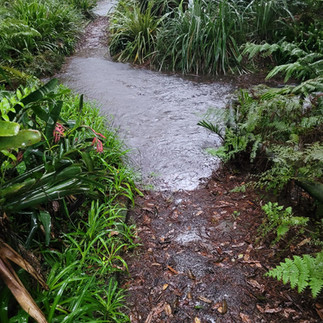
Although the weather was miserable there was a surprisingly large number of people turned up for the walk. Jenaya Munro (NPDC Predator-Free Programme Coordinator ) assisted by trapping volunteer Mark Henderson took us round the Park, to locations of some of the traps used to catch predators and showed us how they work. Three different types of traps are used: DOC200, rat traps and Goodnature A24 automatic traps.

Jenaya explained that there are currently 34 DOC200's, 16 rat traps and 70 Goodnature A24 automatic traps spread across the park roughly every 50-75 metres. DOC200's are the larger trap designed to humanely kill a stoat and weasel as well as rats. The rat traps are either a Victor or a T-Rex rat traps which are housed in narrow boxes to help guide the rodent into the firing line. The automatic A24 traps are working away in the background. They are powered by a gas canister that allows 24 strikes before it needs replacing, the lure pouches are good for 6 months. 


DOC200 T-REX Victor


Below is a video explaining how the Goodnature A24 Automatic Trap works.


Volunteer Mark Henderson checks the parks DOC200's and rat traps on a fortnightly basis. Last year he recorded 104 kills (84 rats, 1 stoat, 1 hedgehog and 15 mice).

The traps are baited with peanut butter and the DOC200's with a fresh egg and salted rabbit meat to attract mustelids (stoats and weasels).

Jeneya explained that there are there are two types of rats caught in Taranaki, Ship rats and Norway rats. The Ship rat - great climbers, has a tail longer than its body and a pointed snout. The Norway rat - the larger of the two, great swimmers, stocky body with a blunt snout.


Jenaya also shared some trapping tips:

  • always use gloves to keep your human scent off the trap and bait.

  • after baiting your trap, don't discard your peanut butter stick, instead you can place it in the ground in front of the trap entrance as an additional lure.

  • scuff and clear the entrance and back of your trap to keep it clear of branches and leaves. Scuffed ground also makes the trap more interesting for passing pests.

  • if you have a rat you're struggling to catch, try baiting an unset trap for a week, allowing the rat to feed for free and get comfortable with the trap. After a week you set the trap and take the rodent by surprise.

  • If anyone is keen to get involved and join the volunteering programme, you can email Jenaya at jenaya.munro@npdc.govt.nz.


Many thanks to Jenaya and Mark for a really interesting walk.


From the Zoo


When is a closed zoo not a closed zoo? By Brooklands Zoo Keeper Jenny Bucksmith


Every summer Brooklands Zoo closes its doors to the public for a few days either side of any big event occurring in the Bowl of Brooklands, in order to comply with health and safety regulations. The biggest downtime is the period around WOMAD. This year, with Te Matatini scheduled just prior to WOMAD, we are closed for a longer period than usual. However, just because the zoo itself is quiet, behind those locked gates the zookeepers are just as busy as ever.  

There is never a day in the year in which staff are not on-site with our animals – even Christmas Day! During closed periods we process all our usual daily tasks, such as feeding the animals, cleaning habitats, animal training, preparing food, doing dishes and processing the administration to reschedule deliveries during concerts/festivals that goes along with everything else. However, the absence of visitors gives us great opportunities to tackle larger jobs that can be more difficult to do with people out and about. Pressure-washing our habitats is one of the first things we try to do (as per water restrictions) and it’s not uncommon for multiple habitats to be extra thoroughly cleaned over a week. Public areas such as the gazebos and picnic tables also get a good clean and it’s amazing how bright and shiny everything looks after a good waterblast!

Maintenance tasks such as replacing fence posts, weeding around fence lines, painting animal houses and dens or planting habitats with new foliage are all jobs we can work together as a team and process. Sometimes an entire habitat might get a huge overhaul. The inhabitants are moved off-display if possible, allowing keepers to dig out old mulch substrates and replace with new, trim trees, replace and/or rearrange furniture and other items within the habitat, scrub structures, and make the area look inviting for the animals when they return. This is always a satisfying job and keepers, animals and visitors alike can enjoy the difference.

So next time the zoo is shut to the public, just remember, it’s still a hive of activity behind those closed doors.


Red and jenny food prep Jo in the Owl enclosure


Friends of Pukekura Park Membership Application Form


To apply for membership, either click on the link to our website page or download a pdf application form


Copyright © 2024 Friends of Pukekura Park, All rights reserved.


Our mailing address is:


Friends of Pukekura Park

PO BOX 484

New Plymouth, Taranaki 4340 

New Zealand


Events Programme March 2025


March

4th     Curator’s Walk.

Meet at the Bellringer Pavilion at 10.30.

18th   Wanderers’ walk.  Predator Control in the Park - Mark Henderson.

20th   Committee meeting.

27th    Annual General Meeting. Historic film footage – the establishment, building of

Brooklands Bowl.


Review of February's Events


4th February - Glyn Church's Garden


Tuesday 4th Feb saw 24 wanderers, (plus a very social wee toddler) meet at Glyn & Gael Church’s haven, south of Ōakura, a microclimate area.

It was an entertaining browse thru their 10 acres of plant forest. 

I just loved the way Glynn interspersed his walk with numerous anecdotes, and LOGIC of plants evolvement, he seems to have a rapture  with them, perhaps a “plant whisperer”?

Fascinating to see, the number of “old fashion” hydrangeas, how they have made an impression on today’s gardeners, and the colours and form, the oak leaf Americans.

The line of staunch phebaliums - apparently they make amazing firewood. 

The multi coloured flame lily also drew a lot of attention.


It was a walk when one would later say to a friend “I wish you’d been there”.


18th February - Wanderers' Walk - Lead Tony Burrell

Eastern Hillside

A small group of 8 for the walk. After much needed rain overnight we had fine conditions. First up was viewing the cycads around the Fred Parker lawn area. The most endangered species in the world today are not rhinos or elephants, they are plants called cycads. The Park has a fine collection of cycads from around the world. They are an excellent fit for a Park in being slow growing, long lasting, excellent form, low maintenance and most produce spectacular large cones. They are dioecious which means the male and females are on separate plants. We were shown how to identify a male or female by the different cones.

Cycads distribution is in the tropical and subtropical areas of Asia, Australia, America and Africa. New Zealand fossil records show we had at least three species of cycad around 15 million years ago. They have all died out.


Cycad Pollination

Cycad pollination is very interesting. Cycads evolved around 300 million years ago along with other conifers. Conifers are wind pollinated. The cycads cones are similar to the familiar pine cones which are all wind pollinated. About 150 years ago Joseph Hooker, an English botanist (who spent time in New Zealand) identified that the female cycad cones had more pollen within them than what wind pollination would deliver. He suggested some sort of insect pollination was likely involved. Further research in the early twentieth century confirmed insect pollination was involved. Wind pollination of cone bearing trees was so ingrained that it continued to be believed that cycads were wind pollinated right up to the late twentieth century. Animal assisted pollination was assumed to have developed with the evolution of the flowering trees over 150 million years later. Recent research has shown that beetles pollinate nearly all cycad species, with wind used only as a backstop if the beetles are absent. The scales on most cycad cones are arranged in a spiral pattern. When the pollen inside the male cones is ready for dispersal the cone tends to unwind, allowing gaps for beetles to enter. They breed within the cone and feed off the pollen tissue. Life is really good for the beetles with no incentive to move on. Cycad need the pollen to be transferred to the female cones so they have developed a unique push-pull pollination strategy. The male cone has a cycle where it heats up in a process called thermogenesis, releasing a volatile chemical which repels beetles in high dosage. The beetles load up with pollen for their journey and head out. Female cones which are ready for pollination also unwind and attract the beetles using the same chemical but at a low dosage which attracts beetles.  The male cones cycle the thermogenesis so the chemical returns to the low volatile state attracting beetles back again.


As we started climbing around the Eastern hill we were shown the yellow ripe cone of Encephalartos villosus called the poor man’s cycad as it is easy to propagate and cheap to buy. It is a South African species and seeds well in the park. The red coloured seeds are highly poisonous, as is the rest of the plant. It has been said just two seeds will kill a dog. Good reason to tell dog owners to keep their dogs on a leash in the park.


Doryanthes

A bit further on we were shown the two species of Doryanthes which are some of the world’s largest lilies. These develop a long upright stem up to 5m in height with a crimson flower head at the top. The closest one from the path was called Doryanthes palmeri. The weight of the massive flower head causes the high stem to bend over like the wind wand. The other species further up the top was called Doryanthes excelsia. Its tall flower stem was perfectly upright as its flower head was smaller and no doubt a lot lighter. Both lilies are native to the coastal areas of New South Wales.

The flowering was well over during our visit and only the seed capsules remained on top of the stems.  The leaves grow in a rosette and are sword shaped up to 3 metres long and around 100mm wide. The leaves are corrugated along their length which adds strength and would also help channel water towards the centre. They do not tolerate frosts. They can take up to 14 years to flower and that rosette will not flower again. A new rosette will take its place. Fortunately the park has a number of Doryanthes so we will be able to witness the spectacular flowering at regular intervals

Kauris

We then viewed some of the overseas kauris in the Agathis genus. This genus is native to Australasia and South East Asia and interestingly our own iconic Kauri name is also used as the common name for all the other overseas species. The two close to our path were native to New Caledonia. The lower one was called Agathis moorei. It was named after Charles Moore, the director of the Sydney botanical garden, who collected specimens during a visit to New Caledonia in 1850. Curiously, due to a mix-up of the type specimens, this tree with lanceolate leaves was named Agathis moorei whilst a tree collected by Moore was named Agathis lanceolata. On the high side of the path was Agathis corbassonii. This species has been revealed to be so similar to Agathis moorei that in 2010 it was included within the moorei species. As with many changes this has not been universally accepted and more research is underway. New Caledonia is an island hotbed of plant diversity. There are 5 named species of Agathis there where we have only one, our mighty Kauri Agathis australis.

Further up the hill we saw Agathis robusta the Queensland kauri. It is native to Queensland and New Guinea. This tree produces a high quality timber which led to it being heavily logged from the mid-19th century, with the result that the large stands of these trees, which were once common, are now gone. Parallels to our own Kauri demise.


We doubled back and continued along the path behind the racecourse, admiring a Matai tree which, after rain, showed the blood red patches from areas where bark flakes had recently separated from the trunk.


Further on we meet a couple from Auckland. The husband was a retired arborist who worked at some of the Auckland parks. He was admiring the health of the trees in our park. We travelled down towards Brooklands, with our Auckland visitors in tow, then ambled back along the lake track to finish the walk at the Kiosk.       


27th February - Evening Meeting

 Former Cedar Lodge owner David Sampson told us the story of how he and his wife Noeline fell into the business of selling Christmas trees. He had planted a grove of radiata pine for timber production. In September a few years later, he decided to thin them out. Noeline stopped him and suggested that he should wait until December and sell them as Christmas trees. David thought it was bad idea because the trees looked terrible. However, they sold for $5 each which piqued his interest.

Unfortunately growing an ideal Christmas tree proved more difficult that David imagined.  He started out by growing the trees from cuttings taken from established trees which didn’t produce the desired shaped trees, so they went to planting seedlings. They tried growing and selling trees in pots which wasn’t popular. He experimented with several kind of trees, some of which had branches which grew up at an acute angle, others were too prickly, others didn’t grow fast enough. In the end he went back to the radiata pine. Another reason for picking radiata pine was the smell. For the majority of trees the growing time was about 30 months. Some trees were grown on longer if clients required larger trees.

He planted the trees in a grid layout with the trees exactly 1.6 metres apart. Grass was grown between the trees which was regularly mown with a ride-on mower. David found this advantageous as he could inspect the trees for problems as he was mowing. Dothistroma was a common issue which he treated with a copper fungicide.

Another aspect of the process is pruning which needs doing at least a couple of times. The last prune is done just before the trees are removed. Having the right shape is important but it is very time consuming.

When they first started selling trees David would cut them down and lead them against the wall in his hay barn. He visited the states and found that over there customers cut down the trees themselves. He was reluctant to do that but when he tried it, it was successful. He said the children enjoyed running around trying to find the best tree.

David ended the talk with a tip for anyone taking a tree home. To keep the tree healthy for as long as possible it needs to be put in water as quickly as possible. As soon as the tree is cut it will start sealing, so when you get the tree home cut off 1cm off the bottom.

Many thanks to David for a really interesting talk.


Below is an article written by Virgina Winder which gives a bit more background to the Sampson's story.


From the Zoo

Temporary zoo closure:

  Brooklands Zoo is temporarily closed from Feb 10th to Mar 21st (reopening on Mar 22nd) due to Te Matatini and Womad being held at the Bowl of Brooklands.


  Zoo and Library events:


Recently the Discover It! team coordinated an Animal Enrichment activity at Puke Ariki library which was well attended. During an outreach talk at Puke Ariki library, myself and Keeper Renee were presented with some amazing items made specially for the Brooklands Zoo animals. Keeper staff have commented the items made have been wonderful and many of the animals have been busy engaging with these items.


Photos are of squirrel monkeys, rainbow lorikeet, agouti and Senior Zoo Keeper Renee Downing.


Happy 60th birthday Brooklands Zoo!  On 28 February 1965 Brooklands Zoo opened to visitors for the first time.  Jack Goodwin, a former Director of Parks, envisaged a collection of aviary birds and small animals for the community to enjoy.  The New Plymouth Jaycee Chapter and the New Plymouth Cage Bird Club were key partners who contributed to the construction of the original habitats and the acquisition of birds and animals.  To celebrate, Puke Ariki Library will be displaying some images of Brooklands Zoo from way back when… and after Brooklands Zoo reopens to visitors on Sat, March 22nd the same images will be displayed in the Brooklands Zoo Barn. 


Photos are of the zoo’s opening ceremony February 27, 1965 and the handing over of the Wallaby pen and memorial dovecote on September 5, 1970. The president of the Jaycee, Mr J Brocket, officially handed over the wallaby pen.


BEING THE ONLY MALE, ONE YEAR IN

By Anthony (Red) Brown - Brooklands Zookeeper


Time has flown and I’ve now been the sole male keeper at Brooklands Zoo for more than a year now.

For those that read these articles regularly, you will remember I was working to win over both the staff and the animals, specifically the squirrel monkeys.

Our four boys have, for the most part, decided I’m not such a bad guy. Being one of the people that brings in their food and keeps their habitat tidy is surely helping with building their trust.

Another individual that requires that trust to be built up over time is our capybara, Fernando. Fernando is quite a skittish capybara and has been known to occasionally be spooked by himself standing on a particularly crunchy leaf, depending on other environmental conditions.

Building up that trust with each species and each individual is so beneficial for keeping on top of their welfare needs, ensuring there is no unusual markings or any hard to see injuries without the need to bust out the binoculars. Also, it’s quite a nice feeling to know that your animals trust you and begin to understand that we’re here to look after them.

As for winning over the rest of the team… I think I’m doing alright there! The novelty of being the only guy has well and truly worn off, although I am still called upon often for my ability to reach higher than most of my co-workers.


Picture 1 - Red is checking the body condition of some kune kune pigs

Pictures 2 & 3 - Fernando the Capybara

Picture 4 - Luz 7, a squirrel monkey


Friends of Pukekura Park Membership Application Form


To apply for membership, either click on the link to our website page or download a pdf application form


Copyright © 2024 Friends of Pukekura Park, All rights reserved.


Our mailing address is:


Friends of Pukekura Park

PO BOX 484

New Plymouth, Taranaki 4340 

New Zealand


Updated: Feb 27, 2025


Welcome to the events planned for 2025

 We hope to see many members and visitors alike join us.


Wanderers’ and Curator’s walks

These walks generally leave from the Bellringer Pavilion (unless advised otherwise) at 10.30am and last approximately 90 minutes.

The monthly Thursday meetings (with a speaker and supper) are held at the Citizens’ Advice Bureau rooms near the YMCA on Liardet Street.


February

12th   Committee meeting.

18th   Wanderers’ walk.

           Eastern hillside and bounds walks.

27th   Thursday evening meeting - speaker - David Sampson

David will tell tales of “The Christmas Tree Story”.


March

4th     Curator’s Walk.

18th   Wanderers’ walk - Lead - Mark Henderson

          Predator Control in the Park.

20th   Committee meeting.

27th   Annual General Meeting.

Historic film footage – the establishment, building of Brooklands Bowl.


April

1st  Wanderers’ walk - Derek Hughes.

Derek, talented photographer and artist sees the Park through a different lens to most of us. His skills in showcasing colour, shapes, shadows and light will be shared with us as he focuses on the changing autumn colours, giving valuable photography tips along the way.

15th   Wanderers’ walk - The ornamental weeds.

Their presence and their level of pest in the Park. There are over 24,000 introduced plants growing in gardens and nurseries in New Zealand; a rough rule of thumb is that 10% of these will naturalise (establish in the wild), and 10% of these will become serious pests.

17th   Committee meeting

24th Thursday evening meeting - speaker - Tony Burrell.

Aotea Great Barrier Island ‘Spectacular by Nature’ Garden Tour


May

6th  Wanderers’ walk - Alan Metcalfe.

Local Park historian, member of the Friends and volunteer buggy driver, will lead us on an informative historical walk through the Park.

15th  Committee meeting

20th  Wanderers’ walk - Lead - Cliff Lawrence.

 Cliff will lead us around trees of Gondwanaland.

22nd Thursday evening meeting - speakers will be from the NPDC Events team.

They will talk about the planning and logistics of events and future needs, in Brooklands Park particularly.


June

3rd     Curator’s walk.

17   Wanderers’ walk.  

19th   Committee meeting

26th Thursday evening meeting - speakers - Jayne Bright and Barbara Hammonds, from Seed Savers Taranaki 

Please note: Speakers and walk leaders are subject to change –Any changes will be notified by email and Facebook.


bottom of page