Newsletter - May 2026

Future Events
June
2nd - Curator’s walk. Lead - Ian Hutchinson
Meet at Bellringer Pavilion - 10.30am
Ian will be talking about the trees in the vicinity of the Opening ceremony.
9th - Committee meeting.
16th - Wanderers’ walk. Lead - Nicky Tootill
Meet at Bellringer Pavilion - 10.30am
Join Nicky for a Guided Freshwater Explorative Walk.
Discover the hidden life of our local waterways on a hands‑on, curiosity‑driven walk led by the Wai Connection team. Together we’ll investigate biotic and abiotic indicators of freshwater health, take part in a macroinvertebrate identification workshop, and explore the importance of fish passage and species protection across Aotearoa.
The walk is also a chance to learn more about Wai Connection, a national programme by Mountains to Sea Conservation Trust that empowers communities to understand, monitor, and care for their local freshwater environments. It’s about strengthening our relationship with Wai and supporting collective action for its wellbeing.
Please come prepared with sturdy footwear, clothing suitable for New Zealand’s “four seasons in one day” climate, and a bottle of water. The terrain may be slippery and uneven, so a reasonable level of fitness is recommended. If you require accessibility support, please let the organisers know — we’re happy to help where we can.
We look forward to exploring, learning, and connecting with you alongside the life in our freshwater habitats.
25th - Thursday’s Meeting.
Citizens Advice Bureau, next to the Y.M.C.A. - 7pm
NPDC reporting via Sheryl the Park Lead and our committee Councillor representatives.
Review of May's Events
5th - Wanderers’ walk. Lead - Daniel Coombes TRC environmental Officer Pest Plants
Daniel met us at Bellringer and we had a good detailed discussion and demonstration of some pest plants that TRC focus on. These are a few he mentioned:
Chameleon plant Houttuynia cordata - the variegated one. Chameleon plant spreads aggressively through deep rhizomes, making it nearly impossible to control. It thrives in almost any condition but quickly loses its colorful appeal as leaves fade to green.
The trunk of a large old man's beard. Old man's beard (Clematis vitalba) is a deciduous, woody climbing vine that can grow up to 20-30 meters, characterized by five leaflets per leaf, six-ribbed stems with papery bark, and creamy white, fragrant flowers that turn into fluffy, greyish seed heads in autumn/winter. It acts as a smothering vine, creating dense, tangled masses over trees and shrubs.
The Royal Fern in the park which spreads by contractors moving to different sites. (Osmunda regalis) It is an invasive species of fern that thrives in wetlands, swamps and damp bare ground, crowding out native species. Extremely invasive, smothering small native plants under a dense carpet of leaves and inhibiting germination of native plants.
Snow poppy. Small, oval, leathery leaves have scalloped edges, and stems ooze orange sap if crushed or broken. Long flower stems support pure white, four-petalled flowers (3-4cm across) with bright golden stamens.
Aqua iris - Rhizome mats displace native plants, especially vulnerable species that live on the margins of waterbodies. Causes flooding and changes in the water levels in swamps. Poisonous seeds may have an impact on birdlife.
As always Daniel captured our curiosity – a truly interesting morning
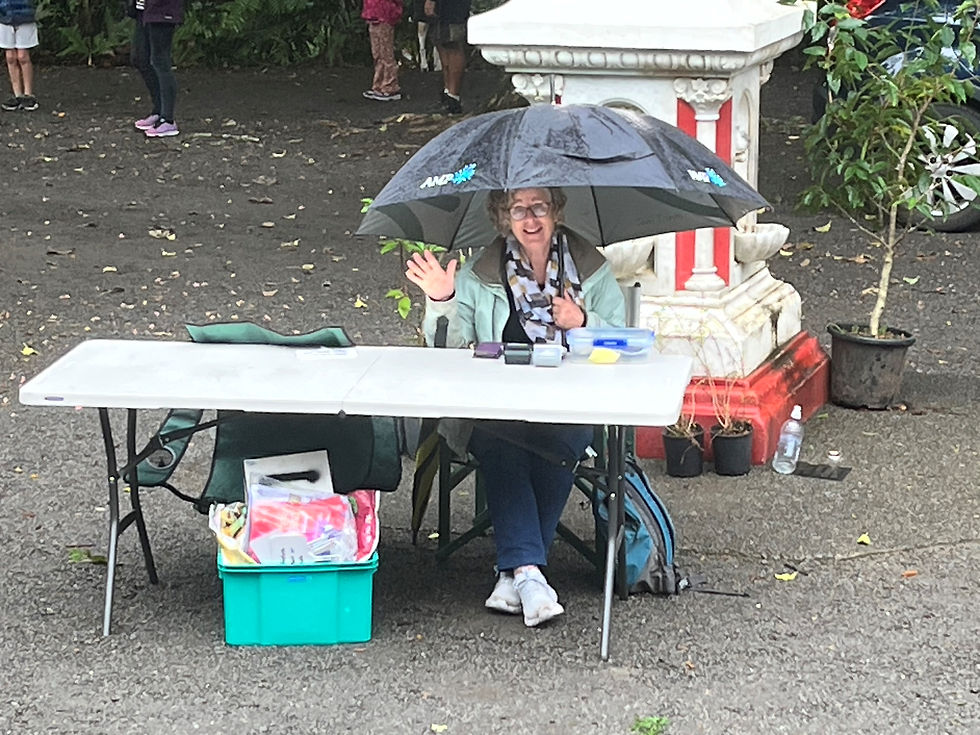
10th - Mothers’ Day Madness – Plant Sale
Thanks to those wonderful members who turned out on 2026 Mothers Day and helped move 5 - 7 ute loads of plants to the band rotunda.
Maureen Johns & David Pattens' utes were invaluable, and David and Kevin , thank you for the deliveries you made.
Definitely four seasons in an hour, as evidenced by the pic of Treasurer Alison who was well prepared for the hordes - which unfortunately really did not eventuate. It wasn't our usual busy sale, but apart from the gloom of what we were going to do with the leftovers, everyone seemed to enjoy plenty of time for socialising among ourselves, while we waited, and waited.
2.5 ute loads were returned to the holding bay via Maureen's ute, for trimming and tidying at a date to be confirmed, for our annual October plant sale.
Successful? Yes, in many ways - financial -approximately $700 raised.
12th - Historic Walks - Lead Alan Metcalfe
We arrived to a lovely fine day with a reasonable number of friends keen to hear Alan’s tales about the park. Alan started by covering how the park came about and the people involved in getting it over the line. We then learned how the sports ground was formed and the developing of the terracing. We then followed down to the children’s playground area with history on the way, including the interesting history of the waterwheel. Alan kept us moving as he was aware we had a lot of the park to cover to get a good overview of the history of the park. History was discussed as we passed the Hatchery lawn, Band rotunda, Waterfall, the Poets bridge, Gables, Brooklands houses, the Bowl, Aotearoa sculpture, Fernery house, with additional historical information on the way. Over two hours of fascinating history on a day with the Park showing its best. Thanks to Alan for designing a well paced walk of the Park’s highlights.
19th - Wanderers’ walk. Lead - Cliff Lawrence (TBC)
A good turnout of 20 people arrived on a calm sunny day. Cliff pointed out the Rimu near the pavilion with die-back. This is close to the Phyllocladus hypophyllus and the giant sequoia which are also showing signs of partial die-back. The park is investigating what is causing the die-back. We walked along the terraces to King fern gully. With little rain recently the ground was firm. We passed a fine group of King ferns. These are likely ancestors of King ferns donated to the park in the early days to form a population in a protected area when there was much concern the ferns were going extinct in NZ. Cliff pointed out some of the tall native prodocarps growing in the gully. We continued around and up to Fort Herbert admiring the large Norfork Island pines. As we continued along to Horton walk Cliff pointed out a Phyllocladus trichomanoides (tanekaha) which had quite large leaves. He suspected it may be a hybrid.
One of the walk highlights was a visit to a Wollemi pine which was donated to the park a few years ago. The pine known by fossil records was thought to be extinct but a small population was discovered in the Blue Mountains just over 30 years ago. The Wollemi pine (Wollemia nobilis) is an ancient species that shares features with the kauri (Agathis australis). Scion group played an important role in perfecting the propagation by tissue culture in association with Australia. All the Wollemi pines in NZ originated from the early tissue culture work at Scion. The first batch of trees made available were quite expensive. Cliff could have obtained one for $450. The first Wollemi in NZ was planted in 2013 at Christchurch Botanical gardens to celebrate their 150 year anniversary.
Garden Explorer
Garden Explorer is a website gaining popularity and use in gardens throughout the world.
Using your phone, find save the link in your favourites. It is then possible to see the map of a specific garden, locate plants and learn about them.
I urge you to explore and play with this app when you visit not only the TRC gardens- Tupare, Hollard and Puke Iti but also if you are travelling. The website shows which gardens are using the Explorer- around NZ and the world. I am a beginner user….. but looking forward to exploring more!
This is from the TRC Tupare Garden Explorer link….
“Use this website to find out about the plants. Our database includes all of Tūpare’s trees and most of the smaller plants. Click on the map tab to show the garden, then zoom into areas to find the plant names and details. Or to find a particular plant, type its name (or part of the name) into the fields below and click search, then select the plant you’re looking for to find out more.”
Sue

From the Zoo
Introducing the New Capuchin Additions
Written by Renee Downing (Brooklands Zoo Keeper)
The capuchin monkeys at Brooklands Zoo have long been a favourite with visitors, known for their intelligence, playful energy, and strong family bonds. Over the past year, the troop has grown in a particularly exciting way, with the arrival of three healthy babies who have brought new life and activity to the troop.
In August 2025, the zoo celebrated the birth of two capuchin infants, Caju and Rio. Arriving just weeks apart, their births marked an exciting period for both the zookeeping team and regular visitors. From an early age, the youngsters could be seen clinging closely to their mothers, gradually gaining confidence as they began to explore their surroundings. Their playful curiosity quickly became evident, delighting onlookers as they learned to climb, leap, and interact with the rest of the troop and each other.
The excitement continued in February 2026 with the arrival of a third baby, Edamame. As the youngest member of the troop, Edamame has been benefiting from the attention of both adults and more confident juveniles, particularly its older sister Pepita. This multi-generational family group is essential for capuchins, allowing younger monkeys to learn important social skills through observation and play.
Capuchin monkeys are highly social and intelligent primates, and the births of Caju, Rio, and Edamame highlight the strength of the breeding programme at Brooklands Zoo. The zookeeping team closely monitors each infant’s health and development, while also providing enriching environments that encourage natural behaviours such as foraging, problem-solving, and social interaction.
For visitors, seeing the young capuchins grow and develop offers a unique and rewarding experience. Their presence also supports Brooklands Zoo’s wider mission of education and conservation, helping to raise awareness about the threats wild capuchins face in South America, including habitat loss and the illegal pet trade.

Friends of Pukekura Park Membership Application Form
To apply for membership, either click on the link to our website page or download a pdf application form
Copyright © 2024 Friends of Pukekura Park, All rights reserved.
Comments