Newsletter - SEPTEMBER 2026

Contents |
October Programme Manawatu Trip Details - November Review of September's Events
From the Zoo - Animal Escape Drills at Brooklands Zoo by Brooklands Zoo Keeper Kelly Green |
October Programme |
6th - Wanderers’ Walk – Susan Oliver will walk us through Te Henui Cemetery. 10.30 am. Please drive in and park at the roundabout, not the parking by the main gates. Also known as New Plymouth Cemetery, is the oldest public cemetery in New Plymouth. It was first used in 1861.Susan leads a team of gardening volunteers and is full of all sorts of information. 14th - Members’ lunch to be held at the Tea House
13th Committee meeting 18th Plant sale 22nd - Thursday's Evening Meeting. Speaker - Elise Smith Elise will be looking at the fascinating geology, botany and sights of New Caledonia, and the geology and history of interesting places visited on the Ghan train trip, from Darwin to Adelaide. |
PLANT SALE |
 |
MEMBERS LUNCH Please join us at Midday, Wednesday 14 October 2025 for our Member’s Lunch (High Tea) at the Pukekura Tea House The cost is $25 per head. Please RSVP by Sunday evening 10 October to Alison – treasurer@pukekura.org.nz To confirm your booking, please pay $25 by internet banking to: TSB Account Name: Friends of Pukekura Park New Plymouth Incorporated TSB 15-3953-0539316-01 Please ensure your name is included and “Members Lunch” |
Friends of Pukekura Park – Bus trip to Manawatu Thurs 26th - Fri 27th Nov 2026 |
Thursday 26th Nov 8.15am - Depart Bellringer Pavilion 10.30am - Arrive Paloma Garden, Pohutukawa Lane, Fordell. Depart 11.30am 12.15pm - Arrive Spring Bloom Nursery, 70 Pearce St Halcombe. Depart 12.45pm 1.00pm - Feilding …lunch somewhere, own cost. Depart 1.45pm 2.00pm - Arrive Chatswood Garden Kairanga/Bunnythorpe Rd. Depart 2.45pm 3.00pm - Arrive Villa Candottii, 133 Reid Line East, Colyton. Depart 4.00pm 4.30pm - Arrive Esplanade Rose Garden. Depart 5pm 5.15pm - Arrive at motel. Own cost 6.45pm - Evening meal somewhere in Palmerston North. Thai perhaps?? Own cost
Friday 27th Nov 8.30am - Depart for Wharerata Arrive 8.45am. Depart 9.15am 9.30am - Arrive Hlomo Hlomo 85 Ngahere Park Rd R.D.2. Depart 10.30am 11.00am - Arrive Lansdale. Karere Rd, Kairanga. Depart 12 noon 1pm - Arrive Springvale Garden centre Whanganui for lunch, own cost. Depart 2.00pm 2.30pm - Arrive Bason Reserve. Depart 3.00pm 5pm - Arrive back New Plymouth
Costs: Van hire, fuel and garden entries based on 10 people $135 per person Motel Fitzherbert Regency Motor Lodge 250 Fitzherbert Ave PNth, close to Esplanade. Four star motel, they will do a continental breakfast if needed. Price to be confirmed soon. We need to get 10 people to make this worthwhile. Could do it with less but the cost would increase accordingly. I need to have confirmed numbers by Friday 16th October to advise motel and gardens. This should be a fun trip, so I hope it eventuates, thanks for supporting it. Tony Barnes ph 027 2915 290 email ; tony.john@xtra.co.nz |
Review of Septembers Events |
1st - Curator’s Walk Arborist talk and walk with Josh Paice |
Seventeen members and a dog gathered for a walk led by Josh Paice NPDC arborist. We explored damage and disease affecting trees in the Park. Josh informed us that there is no confirmed Kauri dieback or Dutch elm disease in the Park. However, pathogens such as Honey fungus and myrtle rust are present, as well as problems like pinhole borer. Myrtle rust affects trees in the myrtle family such as pohutukawa swamp maire and callistemon. Recently a callistemon has been removed from the Brooklands roundabout due to myrtle rust. Josh advised us to check out the trunk of the copper beech near the big Norfolk Island Pines on the Brooklands to see pin hole borer. On the path leading up to the old curators' office we examined the stumps of two large rimu which were removed due to an unknown disease. Josh explained that it could be difficult to pinpoint the cause of a problem, even with the aid of lab testing. He commented that succession planting was required to maintain variety within the Park. In the same area we saw a Cupressus sempervirens (Italian Cypress) that looked in a sorry state. It was infected with bora which resulted in a damaged trunk and falling branches. Just opposite near to the Rogan Street sign was a Phyllocladus hypophyllus (celery pine) that was damaged when its roots were cut and tar seal laid compromising the tree. He told us how the Palm tree on the Fillis St road front had been filled with a stone mix to help aerate the roots. He added that this does help but the gaps in the mix tend to fill up due to rain etc. Near the waterfall we examined the stumps of three rewa rewa cut down to prevent further lifting of the path and damage to the dam. The trunks were left about three feet high to slow disintegration of the roots allowing more time for the gaps to fill naturally. Here Josh pointed out a bracket fungus at the base of a rewa rewa. He commented that more control of new growth would be needed on Cannon Hill due to a growth spurt in an area where pines had been removed. Near the Boatshed Lawn. We looked at Rimu that had been suffering from dieback but were making a recovery. In the same area Josh was able to show us examples of Kauri leafminer eating their way through leaves. Josh told us that if we spotted a diseased tree we were able to report this by sending a photo from the spot either to MPI (Ministry of Primary Industries ) or Antennio the council app. Thanks to Josh for an informative and entertaining walk. |
celery pine Italian Cypress Pin-hole bora Bracket fungus Leaf infested by Leafminer Leafminer
15th - Wanderers’ Walk. |
Twelve of us gathered at the Bellringer Pavilion in overcast spring conditions but we were treated kindly by the weather, with the sun eventually coming out so our walk was completed in mild pleasant conditions. What an amazing showing of kowhai in full flower around both lakes. Some of these trees are very old and probably planted around 100 years ago. The tui were feeding happily on these and they were spoilt for choice with the amount of kowhai in flower and other flowering trees to choose from. Spectacular to see the huge abundance of flowers on the trees, but also the yellow carpet of spent flowers on the ground beneath them. These trees lose their leaves prior to flowering and then grow fresh leaves after flowering is finished. This means the flowers are the star attraction standing out from the bare branches and attracting pollinating feeding birds. We were lucky to have Alan Inch amongst our group as the clivia throughout the park were also putting on a fabulous showing. Alan has a huge knowledge regarding the growing and breeding of clivia and explained how the seed pods are toxic and how various birds have adapted to eating them but excreting the toxic seeds whole. Alan also showed us how to extract the seeds from the pods and simply sprinkle them into the soil and they will easily germinate and grow. He also mentioned that clivia respond well to being fertilized with Bio boost. As we passed by the historic Band Rotunda, Tony talked about the research he has been doing regarding the building of this. Quite a long time elapsed before the rotunda was finally finished, with many different ideas and people being involved along the way. All this history will be revealed when Tony publishes his article shortly. A walk through the park at this time of year rewarded us with some fabulous rhododendron specimens in full flower – Kaponga and Rubicon were dazzling with their deep red colouring along with some stunning pale pinks, lemon and creamy whites in bloom.The flowering cherry by the boat ramp was also a mass of pale pink blossom being reflected in the lake. |
24th - Thursday's Evening Meeting. Speaker - Tony Barnes |
There was a very good turnout for Tony's talk. He shared imaged from 11 notable South Island gardens, shown on the maps below. Details about all of these gardens can be found on the New Zealand Gardens Trust website. https://www.gardens.org.nz/ Tony spoke about aspects of landscape gardening relating to some of these gardens, some of which were good, and some which were not so good (in his opinion). A fascinating talk which I am sure encouraged some of the members to possibly take a trip down south. Many thanks to Tony for taking the time to share his knowledge. 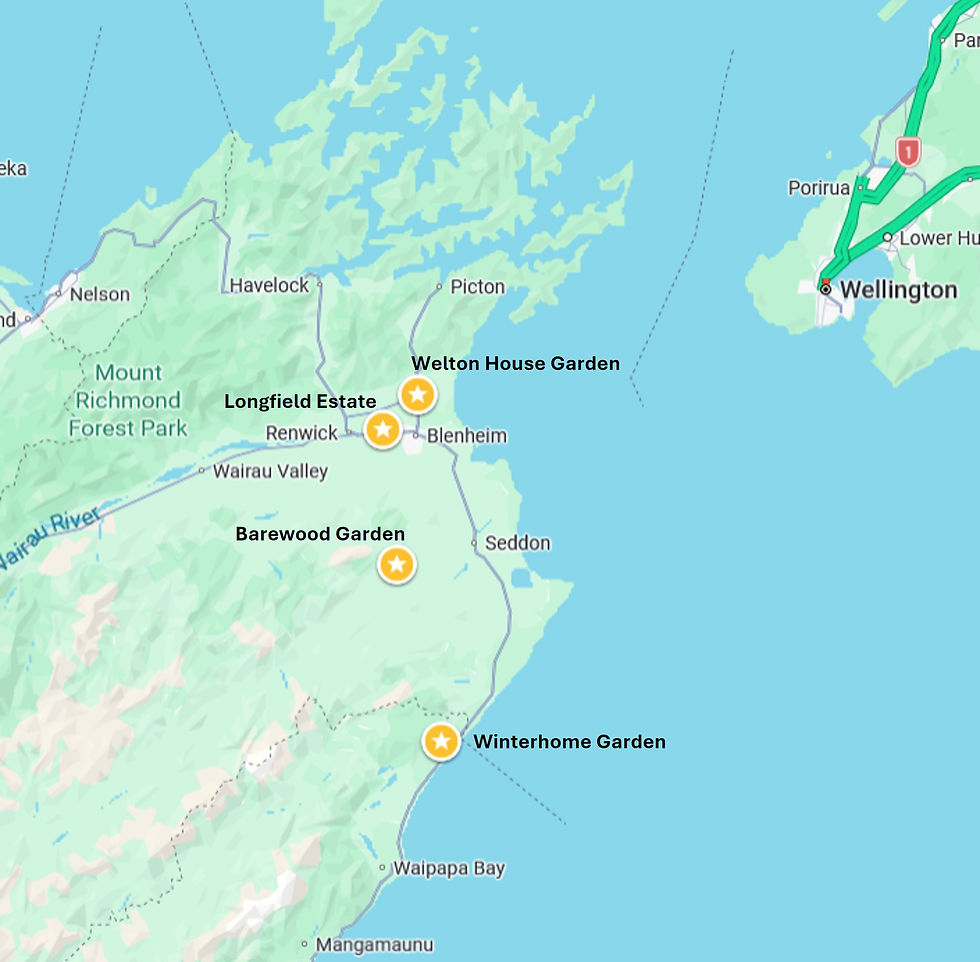  |
From the Zoo |
Animal Escape Drills at Brooklands Zoo by Brooklands Zoo Keeper Kelly Green
Animal escape drills are an essential part of Brooklands Zoo’s commitment to animal welfare, public safety, and regulatory compliance. While actual animal escapes are rare, regular training exercises ensure staff are prepared to respond quickly, effectively, and safely in the event of an incident. These drills help protect visitors, staff and animals, while maintaining confidence in the zoo’s operational standards. In New Zealand, zoos that hold regulated species must comply with containment requirements enforced by the Ministry for Primary Industries (MPI) under the Zoo Containment Facility Standard. These standards require facilities to have documented procedures for preventing animal escapes, responding to emergencies, maintaining containment systems, and ensuring staff are appropriately trained. MPI also oversees compliance through inspections, monitoring, and record-keeping requirements.
 At Brooklands Zoo, animal escape drills are conducted regularly to test emergency response procedures and reinforce staff readiness. During drills, staff practise communication protocols, animal tracking, area lockdowns, visitor management, and coordinated response actions. Public safety is the first priority in any escape situation. Staff promptly assess the situation, notify the appropriate personnel, and consider the safety and impact of nearby visitors. Depending on the species involved, designated staff may close pathways or evacuate the zoo. Although these actions are not actually carried out during drills, staff practise assigning people to these tasks as it varies with each scenario. Clear communication is maintained throughout to ensure everyone understands their roles and responsibilities. Trained keepers use species-specific knowledge and established capture techniques to safely recover the animal while minimising stress and risk. Sometimes a favourite food and providing the animal a clear path back home is all that’s needed, as bringing in capture equipment such as nets might make a situation worse. Capture equipment, transport crates, and emergency response resources are routinely checked and maintained as part of the zoo’s preparedness programme. Following these drills, staff get together to conduct a debrief to evaluate performance, identify any gaps, and update procedures where necessary. Lessons learned are incorporated into future training to support continuous improvement and compliance with containment standards. Through regular escape drills, strong teamwork, and adherence to MPI requirements, Brooklands Zoo ensures it is prepared to respond effectively to emergencies. |
|
Friends of Pukekura Park Membership Application Form
To apply for membership, either click on the link to our website page or download a pdf application form
Copyright © 2024 Friends of Pukekura Park, All rights reserved.
Comments